• Today is: Sunday, July 26, 2026

What Does a Business Need to Survive Online? (Visualsoft eCommerce)

Martina Mercer
April18/ 2014

At eSeller News we deal with a lot of PR and marketing companies, most of whom are very nice indeed and do a wonderful job promoting their client’s products. Occasionally we deal direct with the product inventor or the founder of a new eCommerce store and worry a little that they may be trying to do it all.

When launching a product or an entire store it’s difficult to delegate, the internet is obviously a huge playing field which gives amazing potential for success but many learn the hard way that it’s not simply about setting up shop and hoping for the best.

In the marketing industry myself, I often wish for a clone, and have have no products to sell or promote! To keep up with competition, there are simply not enough hours in the day to do it all.

This is what a product or store needs to succeed online:

A Great Website

This of course is the foundation, please don’t skimp, everything you do from here on in will lead back here. It should be capable of making you proud and of leading your new customers to the checkout

A Great Content Strategy (and the content to implement it)

You know by now that keyword stuffed content is not enough to entice visitors. People (and Google) want entertaining content, they want to find you all over the web, they want to be engaged. A blog a week no longer cuts it, you need consistent, great content across a variety of mediums, magazines, review sites, social networks, forums, YouTube, the list is endless.

Your content should be shareable, as likes and views are no longer enough, you need readers to share, to engage and to come back for more.

A Voice

Your brand needs a personality, a voice that isn’t your own.

Real Time Interaction

Customers now expect any store to be ever present on Twitter, available online or ready at the end of a phone (let’s avoid the offline management it will just make heads spin). Real time interaction is vital for pushing through those conversions.

Connections

You need connections in the PR world, in the editorial industry, in the review sector, you need to connect with the best bloggers on social media and you need them to respect you. These people receive thousands of requests for promotion (or a mention) from start ups and product developers every week, how will you make sure you’re noticed?

Energy

I’ve always claimed that the internet is a level playing field as every store has the same sized shop front. With the right design, content, connections and promotion I believe even the smallest business can compete with the biggest brands.

This requires energy though and a lot of it. You need to keep your finger on the pulse at all times, be the early bird that catches the worm and be constantly adopting new techniques to ensure you shine. It’s such a fast moving industry that even if you’re six months behind the times, the Google updates and the consumer desires, you’ll sink faster than Sue Boyle in quicksand.

Outsourcing

The great news is, you can outsource remotely. You can find freelancers that offer these services from the comfort of their homes. You could have a whole team o people working to promote your products and store but then you need to take time to manage them all.

The Perfect Solution

In my opinion and that of some of the biggest brands we know (see the client list here) there’s one company that offers it all. I was quite staggered by how they’ve streamlined the process for the new ecommerce start up and how through their knowledge and connections they can enable start ups to grow at an alarming rate. They manage the people, they cover every area and they leave you with the time to seal deals face to face, develop your product, attend interviews, feature in local news, basically time to run your business the way you want to without worrying about:

  • Tweeting
  • Web Design
  • Public Relations
  • Networking
  • Product Reviews
  • Content Marketing
  • PPC Campaigns
  • AdWords
  • SEO
  • Promotions
  • Reputation Enhancement
  • Advertising
  • Product Placement

They also do all of this working towards your budget, focused on results so you enjoy healthy returns on your investment from the outset.

The Company of course, is VisualSoft, the team that give you the edge and a significant advantage over your competition. Be recognised from the very beginning by utilising the benefits of the Visualsoft ecommerce team.

Find VisualSoft on:

Twitter

Facebook


Tips on What to Wear to a Meeting

Martina Mercer
April16/ 2014

Men often complain that their choice of clothes is limited compared to a woman’s wardrobe, however when choosing what to wear for an interview similar rules apply across the sexes. Your first impression counts as when you enter the interview arena your appearance will be evaluated before you’ve even said hello.

Many people may assume that a simple suit and shoes is enough to impress the potential new boss, however there are a few additions (and subtractions) that will allow you to exude an air of confidence making them believe you are the right person for the job.

It’s What Underneath That Counts!

Of course the jacket and trousers are crucial; however it’s important not to underestimate the power of the clothes underneath when choosing men’s shirts for the office. No matter how much of a cool customer you are the season or the heating system in the building will only add to your nervous perspiration leaving your shirt resembling that of Lee Evans when under the bright lights of the Royal Albert Hall.

Men’s shirts for the office have varied benefits and when selecting one you should bear in mind the quality of cotton and the breathability, a good shirt will still look clean and smart if you’re invited to make yourself more comfortable by taking your jacket off.

Your Accessories Tell a Tale

You may believe that your accessories play no part in the hiring process however many interviewers are subconsciously swayed by these additions. Although the perfect watch won’t land you the job on its own it may make the difference if your potential employer has a difficult decision to make between two candidates. Keeping bling to a minimum a functional classic watch will show that you find time keeping important, whilst choosing a traditional tie over a clip on will highlight that you don’t cut corners just to get the job done.

Sock it To Them

Although it’s unlikely that they will see your underwear it’s still important that you choose your best as women have harboured this secret for years. Knowing you’re also smart underneath boosts your confidence and allows you to face any eventuality. Your socks will also be appraised and this is where some men fail, as despite understanding that trainers would be a huge negative they still slip on threadbare sports socks that are grey and have seen better days. Instead aim for unnoticeable, no designs or love hearts and certainly not the ones your nephew bought you for Christmas. Simple black, brown or navy (not thermal) will complement your suit beautifully.

The Rest is Up To You

A good suit that’s tailored will accentuate your assets such as broad shoulders and a trimmed waist. Trousers that fit well and don’t encourage you to breathe in as you fasten the button will make you more comfortable and despite popular belief will actually make you look slimmer than trousers a size too small. Ensure the length of leg is optimum, not trailing on the floor but not revealing the hairs on your legs either, and then the rest is up to you. Smile, shoulders back and dazzle them with your expertise and personality so their appraisal rests on your abilities rather than your fashions sense!

Copywriting Services by Martina Mercer

Easy Fixes for Common iPad Faults

Martina Mercer
April15/ 2014

[quote]Promoted Post[/quote]

This is a guest post from Mobile Ease the London iPhone repair shop

Summary: Many individuals and families enjoy the versatility an iPad provides however there are times that issues in performance crop up and to avoid disappointment and frustration they should be dealt with swiftly. This quick guide to fixing common iPad issues will help users get back to using their iPad in no time.

As with all devices the iPad sometimes succumbs to issues resulting in reduced performance or the iPad refusing to work altogether. Often these issues are common ones which may be easily fixed with little effort and no cost.

Problems with Internet Connection

When an iPad loses connection it is usually because the router they are connected via is malfunctioning, the Wi-Fi signal has dropped or the internet locally is suffering an outage.

To encourage reconnection:

  1. Check the home or office internet router
    If other users and devices are struggling with the same connection issues there is a good chance that the problem  is related to the main internet connection or the local supply. To combat this reset the router by switching it off and then after a minute back on again. It often takes a few minutes for the router to reset and you might need to refresh the connection on the iPad however this should fix the issue if it were merely a glitch.

    If this doesn’t work and an error light shows on the router it may be worth contacting the internet provider to check the status of the line.

  2. Check Wi-Fi Settings or Signal Strength
    Often the most simple answers are the most common and so it would be a good idea to try and get closer to the router or find a better location signal-wise if the internet connect and the hub is working ok for other users.

Problems with Apps
Often users find apps suddenly starting to shut down, being slow to load or that they simply don’t work anymore. This could be a glitch with the app itself or it could be that the phone has become so clogged up with residual application data that it is now incapable of working properly. The best thing here is to shut down all of the apps and reset before restarting.

If problems persist remove the app and reinstall it or contact the developer to check for bug fixes.

Reboot Your Phone to Kick-Start Functions
Sometime the magical “switch it on and off again” remedy is exactly what is needed. Even when not in use a mobile is active as notifications still come through, push emails are still switched on and multiple applications continue to run in the background. Rebooting the phone completely, and even better leaving it off for a spell to rest and recover could be just the medicine it needed and users often report that these actions result in a much higher performance level afterwards.

The iPad is a complex device and not one that has been around long enough for many to risk taking it apart to try and repair it themselves. If these simple steps to fixing the most common issues Pad often suffer from don’t work then it could be that the iPad is struggling with hardware problems, not simple software bugs or glitches after all. If this is the case the only option, especially if the warranty has expired is to find a reputable iPad repair company who will restore the iPad back to its former glory once more.


MobileEase offer walk in phone repairs at their base in London as well as postal repairs, aiming to save customers money on costly replacements when often a repair is all that is needed.


A Beginner’s Guide to SEO

Martina Mercer
April09/ 2014

The Beginner’s Guide to SEO

If you’ve recently launched a business online or are overhauling your existing website you’re probably sick of hearing the acronym SEO. This will be a term that many will throw at you without completely explaining the concept.

Here is our beginner’s guide so you can see what all the fuss is about quickly and maybe even have a go yourself!

I know what SEO means, but what does it mean?

This is a very common question. Many people know that SEO stands for Search Engine Optimization, but what does that mean exactly? In a nutshell it means making your site attractive to Google (and other search engines, but we’ll concentrate on the biggy!) so that they put your website on the first page.

Why is the first page important?

The top three positions on the first page of Google receive on average 60% of the overall clicks. The first step is also done as you have put your website in the direct line of vision of your target market. If your website has great copy and eye catching design that pulls the visitor in (leading them to the all-important Buy or Contact button) then you’ve just increased your profits.

Millions of people search every day and any one company could attract thousands of these consumers. You just need to be the first one they see when they want what you have to offer.

Great, how do I make Google fancy my website?

Here’s the tricky bit, however it’s no so difficult that you can’t do it yourself. You need to assess your target market and find out what words they use when looking to buy your product or service. For example, your business may sell chocolate teapots in which case your keywords would be along the lines of, “buy chocolate teapots”, “Chocolate teapots for sale” “Where to buy chocolate teapots”, “Chocolate teapots UK”, “Best chocolate teapots” and so on. You or an SEO expert can do the keyword research to find out which ones you need to use to be in with a chance of making the top spot.

Of course if you sell more than one product or service, you’ll have more keywords to target.

I know my keywords, what do I do next?

Now your keywords need to be inserted seamlessly into your copy at the right percentage. Google abhors copy that has obvious keywords sticking out like a sore thumb and since changing the algorithm they will penalise websites who do this by ignoring them completely.

Then you need to generate Meta Tags to put in the headers of your HTML. This may be when you decide an expert might be best, however over the next few weeks we’ll give you hints and tips so you can do it yourself.


Britain is a Nation of Free Range Shoppers

Martina Mercer
April03/ 2014

The rise of the so-called budget supermarkets, particularly Aldi and Lidl, has disrupted the supermarket ecosystem and more than ever highlighted the importance of understanding the changing shopping behaviour and habits of the British public.

With an explosion of choice of convenience stores, cheaper grocery shops and supermarket price wars, leading consumer rewards app, Shopitize, has identified a new breed of shopper, coined the ‘Free Range Shopper’. Indiscriminate and supermarket-neutral, these shoppers are the manifestation of the metamorphosis of a growing shopping phenomenon.

  • The Free Range shopper is not loyal to a specific supermarket or supermarket chain.
  • The free range shopper shops at their convenience, they are value sensitive and brand agnostic, easily able to switch brand allegiance for any number of reasons, including price, in-store promotions or because of the effects of advertising.
  • The Free Range shopper has no qualms with shopping for line caught cod at Waitrose, and then picking up pasta sauce at Aldi.
  • The Free Range Shopper is a savvy shopper, inclined to a bargain, but not controlled by the prospect.

Shopitize occupies a unique position as the only consumer intelligence product that analyses 60,000 real shopping baskets across the big six UK supermarkets. It analyses real receipts uploaded to its database ensuring that its analytics are entirely based on factual shopping evidence. All other consumer intelligence tools in the UK today are hampered by an over-reliance on data from supermarket loyalty cards, or behavioural surveys. The statistics gathered from these efforts present either a limited picture in the case of loyalty cards, or undependable data in the case of surveys.

The insights generated from Shopitize’s data are of immense value to FMCG brands seeking to develop plans and strategies to grow their categories, their share of customers, and ultimately, their multi-channel revenues.

Shopitize measures hundreds of data points across the big six UK supermarkets, enabling their software to show and cross reference the following [non exhaustive list]:

  • Gender of shoppers
  • Age of shoppers
  • Time of day in which shopping is done
  • Categories of products bought at supermarkets
  • Days of the week in which shopping is done
  • Average basket size of shoppers
  • Average value of basket across supermarkets

Please download the full press release (available in .docx format bel0w) to view results from Shopitize’s study into motivations for British shoppers’ choice of supermarkets.

QUOTES

Graham Halling, Commercial Director of Shopitize commented:

“The fall in supermarket loyalty is an inevitable situation brought about by several factors. There has been a proliferation, in recent years of major supermarkets opening convenience stores on high streets, this has also come alongside a decline of the out of town mega stores and the integration of groceries with general merchandise that fuelled their initial rise. Customers are finding it much easier to do their weekly shop on an ad hoc basis, rather than waiting for the weekend and a trip to an aircraft hangar-sized superstore.”

Carl Engelmarc, CEO of Shopitize said:

“Another major factor is the de-stigmatisation of the discount supermarkets, as is evidenced by the strong figures posted by Lidl and Aldi over the Christmas period. More customers are basing their shopping decisions on overall value rather than supermarket loyalty.  At Shopitize we can track and analyse customer shopping behaviour in real time – giving us matchless analytical understanding of what we describe as the “Free Range Shopper”.

“With the rise of the Free Range Shopper, what we’ll see is supermarkets diversifying and increasing their value proposition in an attempt to increase customer loyalty. We are already seeing this with Tesco recently announcing a pizza delivery scheme. We expect the other leading supermarkets to follow suit.”

Graham Halling explores the concept of the Free Range Shopper in more depth on the Shopitize Blog

The Benefits of Amsterdam Meeting Places for Business

Martina Mercer
March28/ 2014

Amsterdam is quickly emerging as the leader in business facilities as its convenient location and clean, stunning surroundings make it ideal for companies and corporations to hold meetings and conferences.

There are many reasons why Amsterdam is becoming so popular for networking events and annual meet ups and just a few include:

The Price

Hiring a venue in Amsterdam is much cheaper than in our capital city. Along with these reduced overheads the travelling fares are also low. The British can travel o Amsterdam for less than £50 whereas anyone from Europe can fly to the city for the same amount.

The Location

The location of Amsterdam is the perfect compromise for European businesses and some global companies select it as a corporate destination too. It is easily accessible by boat, plane or car and has wonderful transport links around the entire city.

The Culture

Amsterdam is now a melting pot of cultures as it is home to a diverse mix of races from all over the world. This makes it a comfortable place to hold a meeting as it puts everyone at ease and makes them feel as if they are at home.

The Clean Air

London has a reputation in the US as being full of smog and pollution; it is also known for its dreary weather and dull days. This is why many British companies choose Amsterdam to meet their clients as it is known for its fresh air and clean streets.

The Accommodation

Amsterdam hotel owners are used to catering for companies and business people and have developed an unrivalled reputation for their customer care. There are many hotels that surround the square and the city which cater to all needs from informal to luxury spa.

Family Friendly

When travelling to Amsterdam on business many professionals think nothing of taking their families with them. There is so much to see and do that children and partners can enjoy a relaxed holiday as the other half works. This isn’t so possible in other European cities, but Amsterdam caters for families as well as it caters for corporations. It’s also a safe place to play with many of the streets pedestrianized.

The Space

London space is always limited whereas Amsterdam can cater for meetings and conferences holding 3000 people or more.

The Little Extras

When you choose to hold a meeting in Amsterdam you will be offered numerous choices. Unlike other cities you will not just be offered a space to use but also unique events that will make the meet up memorable, guided tours of the local area, help with accommodation and a thorough site inspection to make sure the venue is apt for purpose.

The people of Amsterdam do truly care about your meeting and conference being a success as they want you to return bringing them your business with long term leads bookings in the future.


Coffee with Epson

Martina Mercer
March27/ 2014

When Epson got in touch to let me know they’d be offering free coffee, I couldn’t resist booking them in to find out where this fit in with their new technology.

They explained that along with their coffee shop they were also letting journalists know about their recent contract with Burger King, were they have saved this fast food giant over 70% in printing costs by providing a bespoke solution that can be operated remotely.

Burger King were operating using over 13 different printing and scanning systems which posed a logistical challenge in the ordering of consumables alone. They were ready for change when Epson suggested a solution, an inkjet option that could be rented over time and allowed multiple documents to be loaded at once to be scanned so people didn’t have to wait by the printer or manually load the paper.

Burger King didn’t take on this decision lightly, on testing they set their IT team to work, assessing the cost over time, testing the usability for varying IT levels of staff, exploring the logistics of restocking the printers along with the quality, speed and ease of installation.

Epson, understanding the need to be able to operate all systems from one place, set up a management system from the head office so all printers and scanners could be managed remotely. Burger King’s IT department decided this was a cost cutting option with the ultimate convenience and now they have 61 printers and scanners from Epson which have cut costs by 70%.

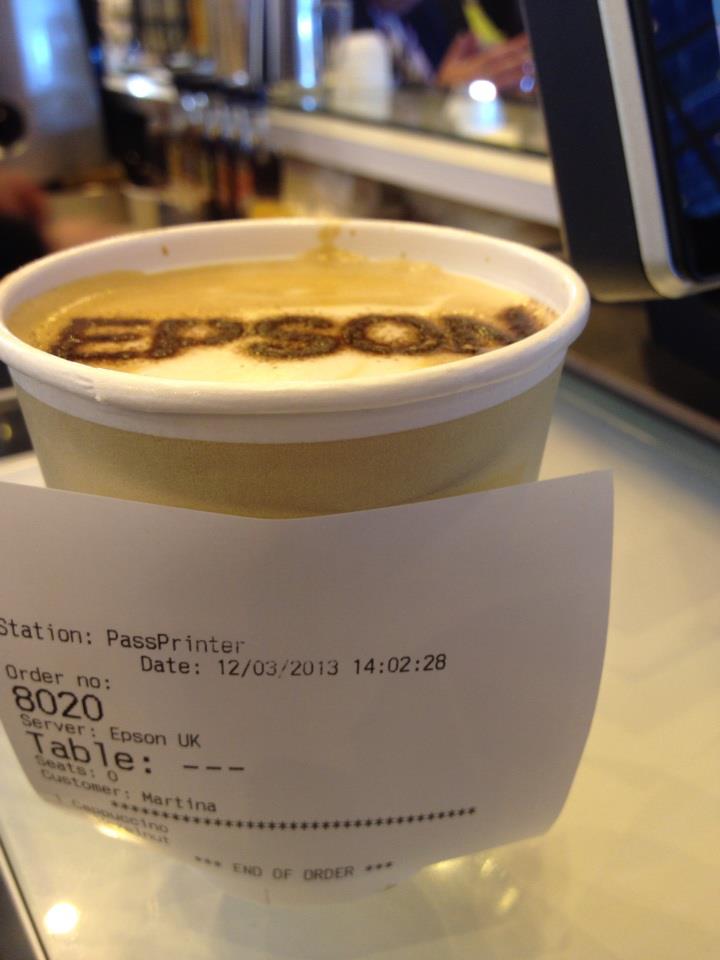
Moving onto the consumer point of view, Adrian Clark, Epson’s Head of Sales for Business Systems took me to the coffee bar, where via a mobile device I entered my name and chose a cappuccino. I was close enough to see how the ticket and receipt was printed before it was attached to my cappuccino complete with my name!

The frothy coffee was finished with a flourish with Epson sprinkled in cocoa powder on the surface, it looked too good to drink, but the taste of the coffee was not why I was here.

I could instantly see the benefits of this Cloud based technology as like any busy person I’ve found myself queuing out of the door at Starbucks just waiting for that espresso hit, or even stood in a queue with a friend while I’ve watched tables fill up before my eyes, leaving us with no choice but to take the coffee out.

With this, I could easily walk into a café; find a table and order, resting my feet while chatting to a friend as the coffee arrived. What this means for the retailer is increased efficiency, allowing them to cut down on queue times and increase customer satisfaction. It also provides an opportunity to merge a customer’s web-based shopping experience with the physical world.

It’s clear to see that with this integration, and information gathered through the Cloud that along with receipts, these POS systems could be printing off loyalty coupons too, encouraging customers to return again and again. It’s no surprise that Epson hold the no. 1 position for POS printing in Europe.

They were keen to describe the recession as our “new economy” and told me how their solutions have adapted to the economic times as their printers not only save on ink costs, while the Cloud based technology saves on staffing, they also save 1/3 on power which propels them into the “environmentally friendly category”.

400 retailers already use Cloud based technology at their POS so integration of this is seamless.


Spreadshirt Beats €70m Revenue As Orders Grow Globally in 2013

Martina Mercer
March25/ 2014

v    71.87m Euros Revenue in 2013

v    Order growth up 12.7% and Revenue grew 10.4%

v    3.3m products shipped

v    Over 72,000 active sellers used Spreadshirt in 2013

v    Average of 2 million people a month have visited the touch-optimised t-shirt designer

v    15% of orders include a touch-screen device as part of the order process in 2013

 London, 25 March 2013Spreadshirt today confirmed that both revenue (10.4%) and orders (12.7%) grew globally in 2013, following a strong December. The e-commerce platform, whichenables brands and consumers to create, sell and buy ideas on merchandising, achieved revenue of 71.87m Euros (£61.03m, $95.45m). These increases can be attributed to platform developments, like the touch-optimised t-shirt designer, and other features which were part of a 2m Euro platform investment. In addition, Spreadshirt benefitted from strategic use of discounting and further marketing measures such as; optimisation of the website and its channels, and new messaging following the rebranding in early 2013.

 Spreadshirt was also ranked 16th in the Pureplay Top 30 International e-Retailers; a joint study by OC&C and Google on the internationalisation of e-commerce, entitled The Global Retail E-mpire

“We truly had a year of innovation at Spreadshirt last year and we plan to continue this in 2014,” says Philip Rooke, CEO. “We introduced our own t-shirt collection and saw the successful introduction of the touch-optimised t-shirt designer. As a result, 15% of our orders now start on a touch-screen device. Although we have not seen huge growth in the UK, we have big plans for the UK market next year, which is highly competitive due to the maturity of consumers and brands. We’re planning a TV advertising campaign in the summer, recruiting more people and positioning for the long term”.

The USA remains Spreadshirt’s strongest and biggest single market with 15.9% revenue growth in 2013, revenue of 28.31m Euros ($37.59m). The more established market in Europe achieved 7.2% growth, to 43.56m Euros.

Spreadshirt’s plans for 2014 include further internationalisation to Australia, Canada and Switzerland and expanding its shipping services to additional countries. 3m Euros will be invested into the platform, to continue to improve the experience from touch-screen devices and to make it easier and quicker for brands and consumers to get their ideas on to merchandising. Spreadshirt will also be focussing on its multichannel approach, which was highly successful in 2013.

Further information and images are available in the Spreadshirt Press Room:

https://blog.spreadshirt.net/press-eu/

About Spreadshirt

Spreadshirt is one of the world’s leading e-commerce platforms for on-demand printing of clothing and accessories. Its customers (individuals, businesses, organisations and teams) can create, buy and sell their ideas on over 180 different products.

The business model includes four areas where sellers and customers can offer or buy a product: Create Your Own, Spreadshirt’s and other online market places, white-label online stores and Spreadshirt’s fulfilment technology. Spreadshirt has over 70,000 active sellers and partners include companies such as The Guardian, Beck’s & Mr Bean.

 Spreadshirt is active in 17 markets and 9 languages ​​and operates four production sites in Germany, Poland and the USA. The company was founded in 2002 and, in 2013, achieved revenue of around 72 million Euros, printed about 3.3 million articles and sent them to more than 40 countries.

 laFraise, the social network for graphic designers and artists, and Yink, a large volume provider for individual textile and promotional printing are also part of the Spreadshirt family.

mCommerce takes the lead

Peer1Hosting
March21/ 2014

Retail giant John Lewis recently acknowledged that its online sales saw an increase in traffic in the early hours of the morning from 12pm and 6am, thanks to their mCommerce capabilities. Although a strange time to be shopping, it comes as no real surprise to retailers whose mobile sites have enabled consumers to shop anywhere, anytime. Christmas 2013 for example was the year of mobile, with sales of £3 billion coming via a mobile device, accounting for over 27 per cent of online sales. Smartphone traffic is now set to reach an all-time high this Christmas exceeding 34 per cent (Google UK market trends, September 2014), truly integrating mobile into commerce like never before.

With this significant development within ecommerce, it was only a matter of time before m-commerce truly came into its own and mobile payments and wallets become the norm.Asda, Sainsbury’s and House of Fraser are just a few retailers that have begun integrate mobile payments into their retail channels, and they won’t be the last. The question therefore lies around how retailers can begin to prepare themselves for the influx of m-commerce.

Can your hardware handle it? 

Many retailers, although operating with omnichannel capabilities in mind, may not have considered the infrastructure to cope with the demands of m-commerce. For example, a retailer who has spent considerable amounts of money ensuring their site can run across multiple platforms may not have an infrastructure with the ability to incorporate new technologies. Trying to stick on the latest technology to an ageing site is not only a significant waste of money, but can also be a waste of time. Retailers need to first take a look at their existing eCommerce offerings, before even considering adding additional capabilities.

Consumers are key 

 Recent research from Skrill found that 28 per cent of people abandon a purchase thanks to the lack of payment methods, a significant number when taking into consideration the budgets and efforts taken to get people onto the site in the first place. Consumer demands are evolving far quicker than anticipated; they expect to be able to trust a retailer and receive a premium experience every time they access the site. If retailers have found themselves under scrutiny because of a lack of compliance with PCI regulations thanks to their new payment options, or due to a clunky online experience, it becomes easy to abandon the purchase.

Research from Invesp has in fact revealed that over 89 per cent of consumers have abandoned a purchase after experiencing a poor customer experience.

With both a retailer’s existing infrastructure and focus on customer experience in mind, they face an onerous task of preparing for the upcoming influx of mobile payments. However, by taking it one step at a time and ensuring that they have ticked every box, transitioning to the mobile world should be easy and highly profitable.

An Interview with Tony Saunders – Vice President of Verifone

Martina Mercer
March21/ 2014

I met with Tony Saunders the VP and General Manager of VeriFone UK and Ireland late into the second day. It was the last appointment before the stands began to pack up and leave for another year.

With the buzz of activity over the last 48 hours we were all beginning to wind down and Tony understood that a comfortable sofa would be just the ticket!

As VeriFone were the last on the list I’d had time to consider their presence in the retail market for a few days before. I’d noticed that almost every transaction I’d made with a card, from the tube station to M&S food had been processed through a VeriFone POS terminal.

I knew VeriFone were huge, I didn’t realise they had the lion’s share of the market. In fact, that share is worth over 60%.

This dominance is no accident as it was clear they were at the RBTE to roll out yet another innovative product which is set to make customers and retailers very happy indeed. VeriFone are evolving all the time and are not complacent about their impressive presence, in fact they’ve recently acquired Global Bay so they can offer the ultimate customer experience.

Already they have the fully mobile till that busts queues, enhances the customer experience and increases conversions. AS Tony said, “If you’re a retailer, every customer that walks out the door without spending anything is leaving with YOUR money”

Yet VeriFone aren’t simply about easy transactions as they are obviously the leaders in providing these card and ticket machines for retail giants across the globe, now with the acquisition of Global Bay they want to focus on giving the ultimate customer service.

Tony and I discussed how queuing at a till is quite an outdated way to buy these days as customers are used to almost instant checkouts online, yet when they get to a store they are expected to waste time waiting for a static assistant to see to them. The mobile tills help with this, as they can manage transactions and cut queues as someone is waiting in line, or even better they can get the person while on the shop floor.

Now, combine this with the new touch screen systems of Global Bay and you have the potential to give everyone the personal shopping experience, even in stores such as Next customers can benefit from their own personal stylist, which is proven to increase conversions, cross sell and upsell all the while increasing customer loyalty.

As Tony explained, “I liken it to shopping in Harrods, for example, if I go to the store to find a pair of Italian leather shoes, a personal shopper will help me with my selection. I may spend twenty minutes choosing and in that time I’ve had personal attention yet when I’ve decided I’m told to go and wait in a queue to pay which ruins the entire experience. “

He went onto explain that this new systems can assess data from previous visits or even shopping online, for example they can see if a shopper has bought certain items before which then brings up suggestions based on their purchase history. All of this is on one screen and displayed by a sales person on the shop floor. If the customer likes the suggestions on offer stock can quickly be checked and the consumer can check out there and then, leaving with a lighter pocket but with a bigger smile on their face.

This integration of Global Bay is exactly what is needed in bricks and mortar stores right now in order to fight the recession. It’s no secret that to survive, retailers must be able to offer the ultimate customer experience and VeriFone do just that.

 About VeriFone

VeriFone are the leading provider of payments terminals in the world with NFC and the multichannel experience high on the agenda VeriFone is ahead of the game in terms of contactless/NFC solutions and is championing technology designed to drive new services for retailers and a better experience for consumers. VeriFone believe that retailing is not just about devices. It’s about services and total payment solutions. VeriFone’s PAYware Ocius platform is reducing the burden of payments for retailers – making PCI compliance easier and helping them manage their POS estates and payment systems more effectively.